


The fire smelled wrong. Lyra knew the smoke of Eschenwacht: alder wood, fish, the sharp resin smell from the communal house. This clung sweet and greasy to her tongue. She pulled her wet cloak over her mouth and ran. Two hours ago she had been looking forward to Maerin's stew. Now the bag strap dug into her shoulder, and she could not get over the rise fast enough.
She stopped at the top. Eleven households, three smoking sheds, the horse pasture. Her gaze darted from one familiar roof to the next and found the gap. The communal house had collapsed. The well's lifting arm stood out against the flames. Its rope hung still.
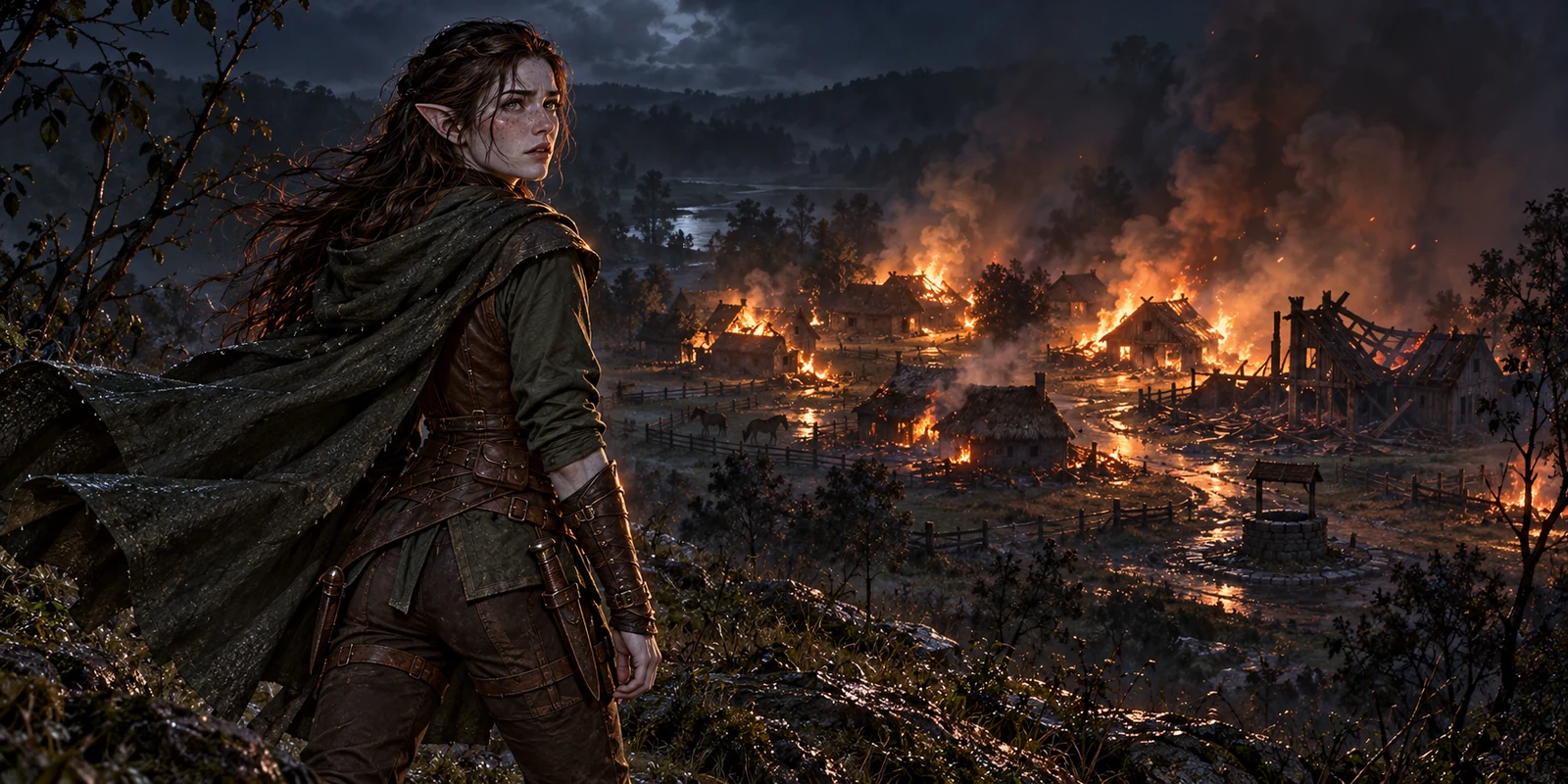
She had her right-hand dagger out before she noticed the cart. It stood across the entrance. Two men were heaving a crate onto its bed; one wore a pale band around his upper arm. A third was reading from a folded sheet. Lyra waited for one of them to run to the well. The man with the sheet moved his finger to the next line.
Beneath the bushes, the old drainage ditch ran towards the pasture. Lyra crouched. As a teenager she had crawled into it to escape the bill for a broken window. Dirt beneath her nails, Maerin's voice above her. She could hide, Maerin had said. She just ought to know who she was sending out to look for her. Lyra parted the branches and slipped down. She would have given a great deal to hear that voice above her now.
A dead goat blocked the ditch. Lyra stepped over it, watching the fence. Under the willow withies, then she would be at the feeding troughs. The rear gate had been broken open. Two horses were missing. The third threw itself against its tether until the rope sliced taut through the air. She cut it and jumped back. The hot, wet flank brushed her arm, then the horse was through the gate.
“Maerin.” Too quiet. She drew breath but could not get the name out a second time.
The door of the dyer's house hung crooked on its hinges. A hand lay on the threshold. The copper rings were still on it. Lyra stared at them. Then the fingers curled. She rushed out of cover and dropped to her knees beside the woman.
“Don't pull.” The dyer coughed blood into her sleeve. “Beam.”
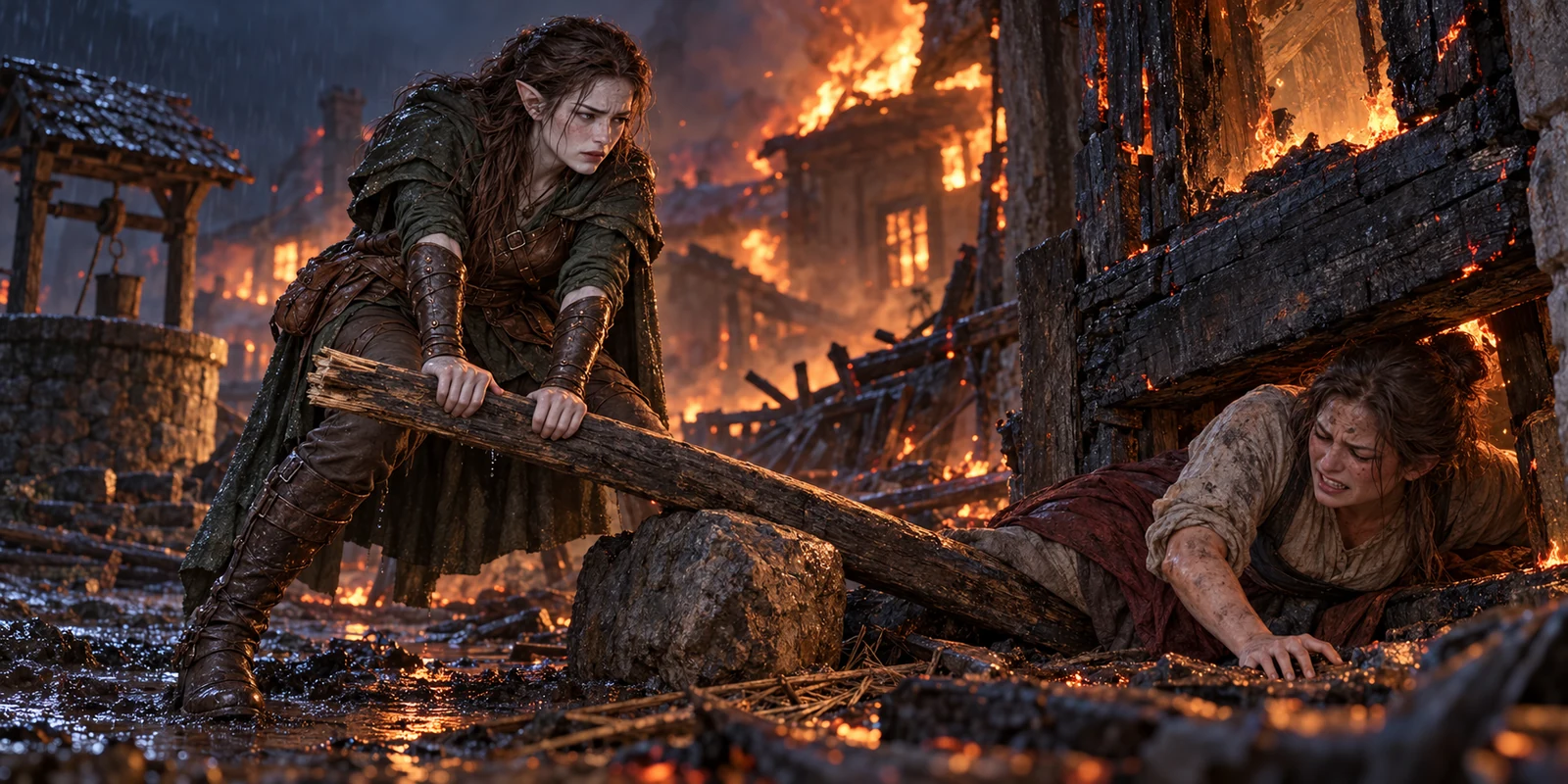
The lintel pinned her left leg. Lyra thrust the dagger between two paving stones and reached under the timber. Soot smeared her fingers. She heaved. The beam stayed where it was. Again. Something pulled sharply in her back; above them, wood cracked. The dyer craned her head up.
“A lever. You were always the clever one.”
Lyra laughed, a short, ugly sound. Clever. Of course. A broken handcart shaft lay beside the well. She fetched it, wedged one end under the lintel and threw her weight onto the other. The wood groaned. A hand's breadth. The dyer dragged her leg free and screamed. Lyra was still forcing the lever down when the woman was already clear.
She tore the dagger from between the stones, sheathed it and hauled the dyer up. The woman clutched at her cloak; every other step, they buckled. The basket-maker's son sat by the fence, a burn on his neck, bare feet in the dirt. That morning he had been laughing at her blunt dagger. “Here.” Lyra pushed the dyer's hand towards him. He did not move.
“To the stream. Under the alders.” He went on staring at his feet. Lyra took his face in her hands and lifted it towards hers. “Do you hear me? If anyone calls for you to stop, keep going.” Now he looked at her. She had to make herself let go. “Maerin. Have you seen her?”
He nodded towards the collapsed communal house. “She went back.”
Lyra ran to the well.
Soot lay on the well's rim. Lyra braced herself against it for a moment, looked for the passage behind the house and saw the piece of wood beside her boot: two notches, a copper pin. One of Joren's freight tags. Yesterday he had unloaded salt here. Edda had argued with him over the price until Maerin called them both in to eat. Lyra pocketed the tag. Someone moved behind the fallen roof.
Maerin came out of the passage between the storeroom and the washhouse. Her grey braid hung half undone over her shoulder. She pressed her left arm against her ribs; her right hand was closed. Lyra took a step towards her. Maerin stopped and gave her the angry look that used to make her duck lower in the ditch. There she was. Standing on her own feet.
“You were supposed to be on the north road.”
“The north road didn't offer me anything to eat.” Lyra caught her uninjured elbow. “We're going.”
Her hand came away wet. She drew it back and saw the blood on her fingers. Maerin's sleeve was dark, but beneath her arm a broken arrow shaft jutted between her ribs. Lyra reached into her bag. Bread, the half-eaten apple, soap, string. She rummaged through everything and felt into the corners again, as though the second search might turn up something different.
Maerin pushed her hand aside. “Not here.”
Footsteps by the well. Lyra pulled Maerin into the wash passage and held her close while she looked out through a split between the boards. The man with the sheet was kneeling beside the dead woman in the road. Now Lyra could make out the white band on his upper arm, its grey border; the mark on it vanished into the smoke again. He turned the dead woman's face towards the light. Then he made a stroke on his paper.
“The little one's missing,” he said in the trade language Lyra had learned on courier runs. “Alive. Those were the orders.”
The second man said something about the cargo ledger. The other struck him in the chest with the folded sheet, hardly harder than someone hurrying a servant along. Lyra watched the hand holding the paper. Clean nails. A pale signet ring. The cuff was burned. She looked so closely that afterwards she could have drawn those fingers.
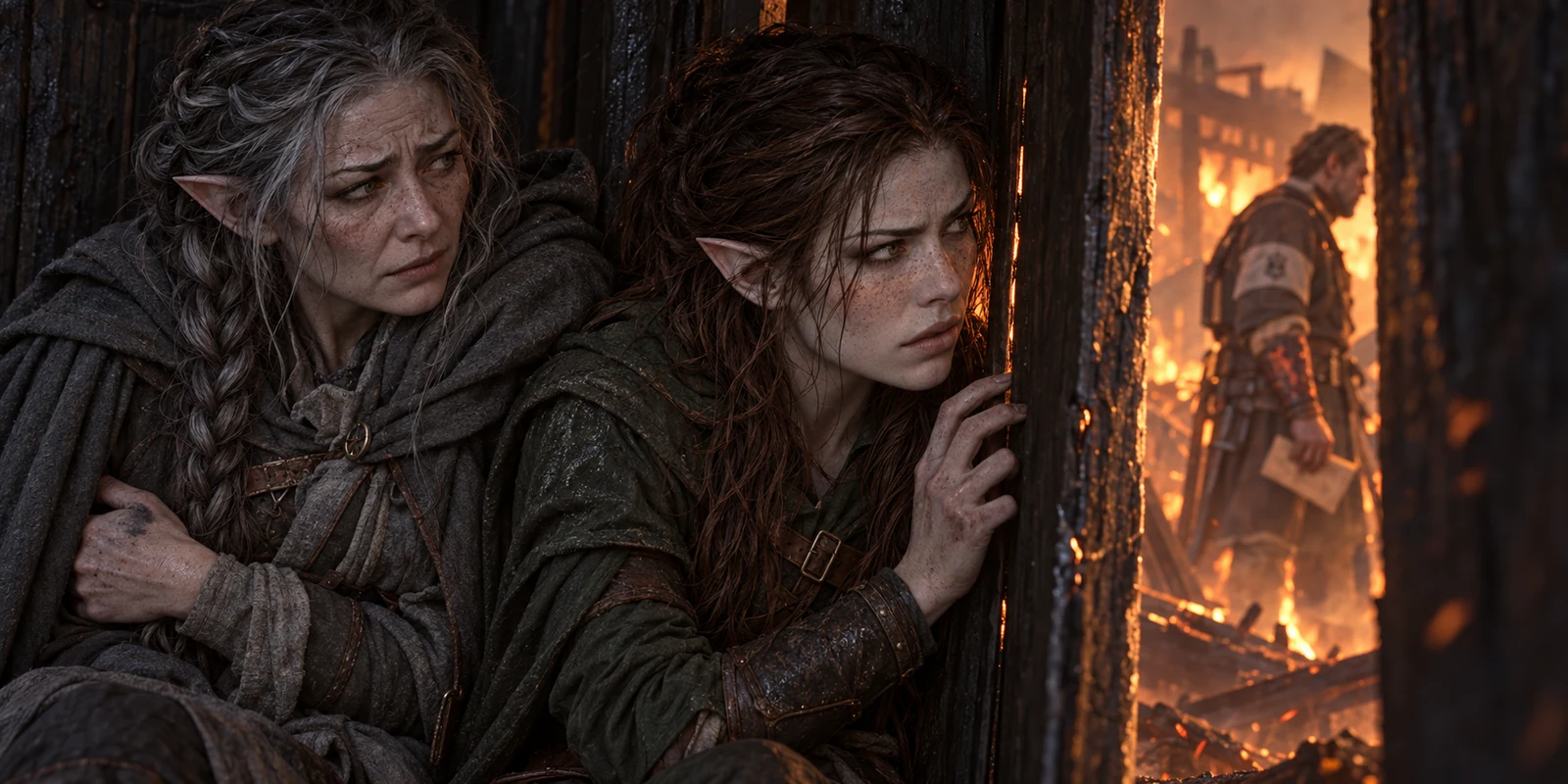
Two cold fingers settled over her mouth. Maerin pointed towards the low shed behind them. Its roof reached the hillside wall; they could get across there. Lyra used to hide apples beneath it and had known which boards creaked. She looked back at Maerin and nodded. If she could only get Maerin onto the roof.
Lyra climbed up first, knelt at the edge and pulled Maerin after her. A shingle broke beneath her left hand. Her palm slid across the sharp edge; only when blood ran over her wrist did she understand that she was bleeding. Maerin's cloak had caught on a nail. Lyra drew the right-hand dagger, sawed through the cloth and had to catch the hilt again as it slipped in her wet fingers. Then Maerin was free, and she pushed her over the wall.
Maerin hit the ground on the other side. A short fall, too hard a sound. Lyra jumped after her, skidded down the slope on her knees and caught her head before it struck a stone. Maerin's mouth stood open. Lyra held her and waited for a breath. Below them, the narrow ditch led to the stream, hidden from the road by the bank.
“Keep going,” Maerin said.
“Just to the water.” Lyra brushed the hair out of her mouth. “Then we'll have a look at it.”
She drew Maerin's arm over her shoulders and struggled upright with her. At every step the arrow shaft pressed between them. The stream was less than a hundred paces away. Lyra knew every foothold here, yet now she had to probe for firm ground with her boot and could scarcely get Maerin forward. Voices rose above them. They sank to their knees. Maerin clenched her teeth; Lyra felt her jaw trembling against her temple and held her own breath.
The dyer sat beneath the alder by the water. The basket-maker's son had put a cloak around her. Two neighbours were with them, one with a bloody forehead, the other holding an empty basket. She clasped it so tightly that her knuckles showed pale. Lyra tried to lead Maerin over. Before the others could stand, Maerin planted her feet and resisted.
“Not all together. The old fisherman's path. Tell them.”
Lyra pointed west, described the bend beside the rock and the little hollow before the sea. As she spoke, she propped Maerin against the alder trunk. Her voice held steady. The others nodded and began gathering their few belongings. The young man offered to carry Maerin. She shook her head, reached into Lyra's open bag and took out the soap.
“For the wound on your neck. Clean water first.”
He took the piece in both hands and looked at it. Then he helped the dyer up. The four moved off slowly, the worst injured in front so the others would stay with them. Lyra watched them go. Maerin was still standing beside her and still knew what to do. For one ugly moment Lyra wanted to shake her. She ought to sit down at last. She ought to let someone help her.
Lyra lowered her against the trunk and tore a strip from her undershirt. She pressed the cloth around the arrow shaft as carefully as she could. Maerin's cold fingers closed around her wrist. Sparks drifted through the alder leaves. One settled on the water and died with a barely audible hiss. Lyra watched it until Maerin's fingers twitched.
“You told me to count,” she whispered. “Breathe with me. One. Two.”
Maerin tried. The third breath would go no further. They both waited for the fourth.
“In my hand,” Maerin said at last.
Lyra opened her fist, finger by finger. In the palm lay a plain ring of black metal. Smooth inside; a tiny notch outside. Lyra picked it up with the thumb and forefinger of her right hand. It was warm. Not from the nearby heat, she thought, without knowing why she felt so sure. Blood dripped from her left hand onto the wet cloth. She moved it aside so none would run into Maerin's open palm.
“Who wants this?”
Maerin looked at Lyra's collar. Beneath it lay the wooden pendant she had worn for as long as she could remember. She pulled it over the edge of her leather vest: a flat piece of dark wood, chipped along one side. When she held the ring beside it, the tiny notch fitted that edge exactly. Her fingers went still. She had held the pendant countless times, while waiting, while falling asleep, and had never looked for anything in it.

“Don't open it for them,” Maerin said.
“Open what?”
Maerin's gaze slid past her. Lyra turned. Stream water ran over the pale pebbles; branches stirred on the opposite bank. When she leaned over Maerin again, the older woman tried to smile. She had sometimes looked like that when she had something to confess and Lyra had first slammed the door in her face.
“Beneath what gave us water. I wanted to...” She swallowed and whispered, “When the seventh crown awakens, the dead will dream again.” Her grip tightened as if she wanted to take the sentence back. “I wanted to tell you myself.”
“Then tell me.” Lyra bent closer. “You're still here.”
Maerin raised her hand. Halfway up, it sank again. Lyra caught it and laid the rough fingers against her cheek. There was a small ink stain on the middle finger. She rubbed it with her thumb but could not get it off. Maerin had been writing that afternoon. At her table, perhaps with her elbow beside the cold stew, while Lyra waited in the rain on the north road. They could still have talked. Lyra pressed the fingers harder against her skin.
“Don't go back,” Maerin said.
It was her last intelligible sentence. After that there was only air, faltering, with long pauses. Lyra kept counting quietly, lost her place and began again. At last she listened only to the stream. The water kept going without ever having to draw breath. Maerin's hand lay heavy against her cheek. When Lyra lowered it, there was no movement left; she laid it on the grey cloak and went on holding it there.
She waited a little longer. Not for a miracle, she told herself later. Only to find that she had been wrong.
The east was growing light before Lyra stood. The others must have reached the fisherman's path by now. She looked for something to dig with. No spade, only roots, stones and wet leaves. Not even a dry rag to cover Maerin's face. Lyra found a hollow between two roots and dragged her into it, a little at a time, by the shoulders, then the legs. She covered her with the cloak and went to fetch stones.
At the third stone her left hand gave way. She sat beside Maerin in the leaves, bit a strip of cloth apart and wrapped it around her palm. Too tight. Her fingers stiffened; the pulse throbbed right to their tips. She loosened the bandage. Maerin would have scolded her long before, taken the cloth from her and kept scolding while she bound it. Lyra sat there almost waiting for her to do it. Then she picked up the next stone with her right hand.
She threaded the black ring onto the pendant cord. She tied it twice, tugged to test the knot and slipped ring and wood beneath her tunic. Her hand met the freight tag inside her bag. Two notches, a copper pin. Joren had been in the village. A great many people had been in the village. Lyra rubbed her thumb over the wood and saw Edda beside the salt sacks again, Maerin in the doorway. She put the tag away.
Something came crashing down above. Lyra flinched, dropped the stone and flung an arm over her head. She crouched like that for a while. The communal house had creaked in the wind since her childhood. Its roof had had seven leaks; Maerin had always insisted Lyra was imagining the eighth. Whenever it rained, Lyra had fetched the eighth bucket and set it down particularly loudly.
Last autumn they had stretched cloths beneath the beams. The dyer had pushed a soup pot beneath the biggest leak, and Edda had insisted the pot belonged in a kitchen, even if the roof had decided otherwise. Lyra could still see them all standing there among the buckets, arguing over that pot. She could have repeated every word. What Maerin had said to her before bed yesterday would not come back.
She tried to hear it in her voice. A question about the weather? Had she still not mended the cloak? But Maerin could have said that on any evening. Lyra lowered the stone slowly onto the cloak. Yesterday she had probably scarcely listened. She kept searching even when the possible sentences had long since begun running into one another, and grew angry at herself, at the roof, at the stream that kept interrupting her search.
A bird called from the trees. She looked up. Soon the men would widen their search beyond the village; she had to go. Yet Maerin's undone braid was still lying in the wet leaves. Lyra knelt beside her one last time and tucked it under the cloak. A loose thread hung from the edge. She plucked it off, as she had always done with Maerin's clothes. Only when it lay between her fingers did she stop.
She wound the thread around a small pebble and laid it on top of the stones. The grey cloak still showed beneath them. Lyra shifted one stone into place, took her hand away and left it there. Then she stood. Her knees would not straighten all the way until the second attempt.
She followed the stream until she could see the road from a rise. Below, they were turning the cart. People sat on its bed, roped together. Lyra counted five heads. A face vanished behind a shoulder, grey hair beneath a dark cloth. Edda? She waited for the woman to turn again, but the cart was already moving on, and the face stayed hidden.
Lyra drew the right-hand dagger and put one foot down the slope. Four armed men walked beside the cart; an archer stood at the roadside. She searched for a gap between them. Her left hand throbbed; a short while ago she had not even been able to hold a stone with it. Perhaps one man would fail to see her coming. The archer afterwards would not. She drew her foot back and stayed where she was, gripping the dagger so tightly that the hilt hurt.
The man with the sheet folded his paper. Lyra fixed the cart in her mind: the broken slat at the back left, the patched cover, the pale wheel rim. The wheels crunched as it set off. She followed it with her eyes into the trees, and for longer still through the gaps beyond. Only when there was nothing left to see did she breathe out. She had let them be taken away.
She found no one on the fisherman's path. At the agreed bend, the empty basket lay carefully on its side. Beside it, an arrow made of three pebbles pointed west. The basket-maker's son had listened. Lyra crouched and took one pebble with her. If he came back, he would see that she had been here. She closed her hand around it before putting it in her bag.
She drank from the stream and ate the last of her bread. The water tasted of earth; the bread would only go down in small bites. As she chewed, her jaw began to tremble. She waited, took another sip and then washed the blood from the dagger blade. Her face lay in the metal between the water marks: freckles beneath soot, eyes wide open. She brushed a hand over her mouth. The unfamiliar set of it remained.
The birds were calling again, as though the coast path belonged to them alone. Lyra kept to cover and looked back after every bend. Once she stopped for a long time and listened until she could quiet her own breathing. At the third bend a broken fern lay across the path, its fresh underside facing up. At the fourth she looked around in vain. Whoever had snapped it was no longer behind her.
A man stood between two pines. His shoulders filled the narrow path. Dark hair was tied at his nape; beneath the worn cloak lay metal. The broad sword stayed in its place. Lyra looked at it first, then at the right hand hanging motionless at his side. Beneath his brow his face lay in such deep shadow that she could see only black where his eyes should be.
She drew the second dagger with her left hand and forced her fingers around the hilt. Beneath the bandage it grew warm and wet. The man looked down. He stayed where he was.
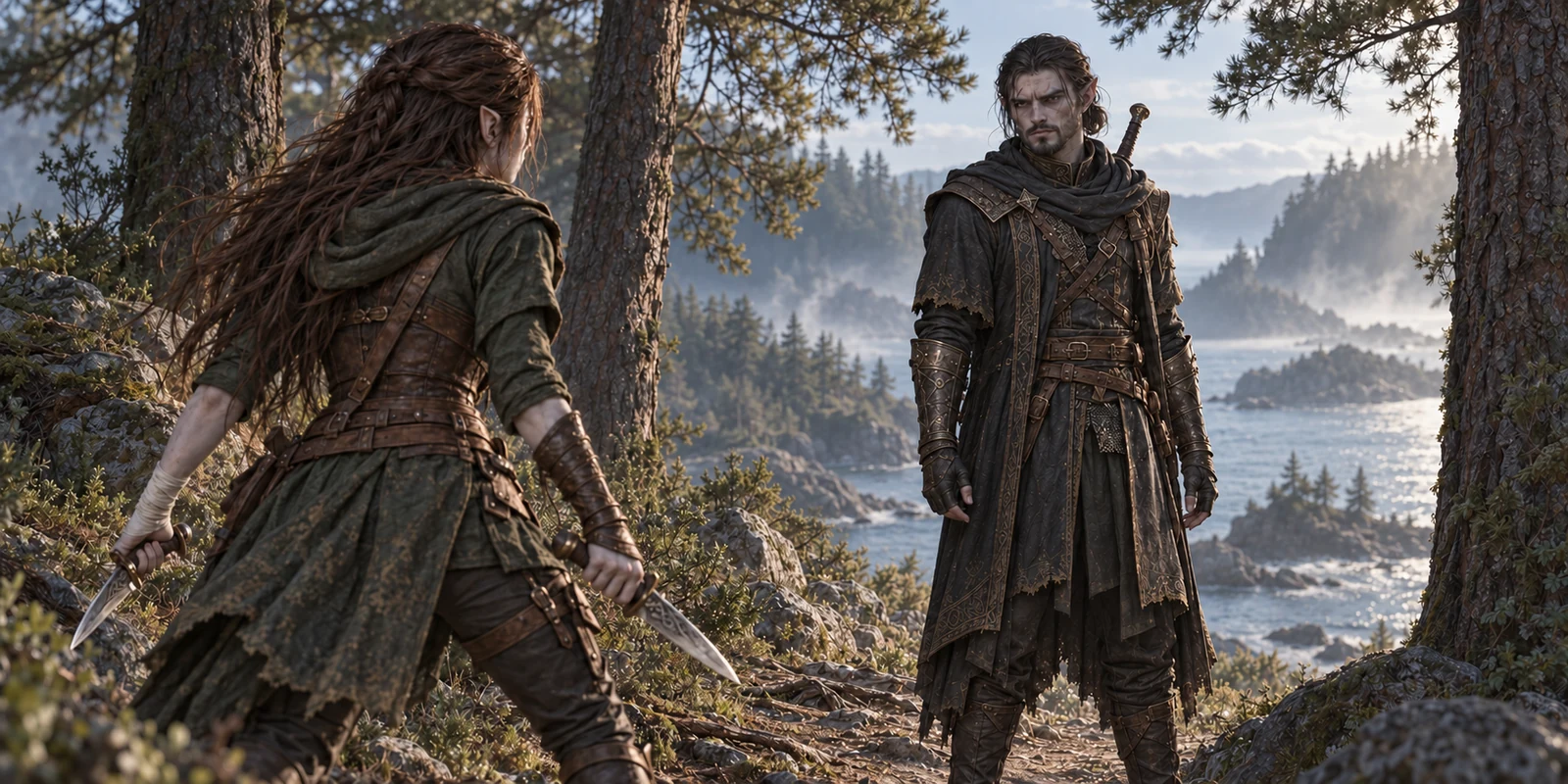
“Lyra Nachtfeder,” he said in the same trade language as the men at the cart.
She raised the blade. “Bad day for introductions.”
He glanced at the smoke beyond the trees. Lyra waited for some change in his face, something she could pin him to. When he looked back at her, she was still unsure. He might regret what had happened there. He might simply be judging how much time he had left.
“You have to come with me.”
Under her tunic the black ring lay against her skin. For the first time it felt cold.